TL;DR
- Teradar raised $150 M to commercialize a room-temperature, solid-state terahertz (0.1–0.3 THz) sensor that aims for radar-like durability with lidar-level resolution at a few hundred dollars per unit.
- Automotive readiness (ISO 26262 ASIL-D, AEC-Q, PPAP, EMC/EMI, global homologation) and real-world performance in rain, fog, and behind radomes remain the gating factors.
- Early integration should be hybrid: pair terahertz with imaging radar and cameras for redundancy, and run structured validation tests in 2025–2026.
What Changed—and Why It Matters
Teradar says it has secured a $150 million Series B to bring a “modular terahertz engine” to market, promising the low-cost scale of radar with the fine resolution of lidar. The Boston-based startup claims its solid-state, all-weather terahertz-band imaging sensor can operate at room temperature—no cryogenic cooling—and cost “in the few hundred dollars” per unit at volume. That price point sits between modern 77–81 GHz imaging radars (typically $100–$250) and automotive-grade lidars ($500–$1,000+).
The company reports engagements with five major OEMs and three Tier 1 suppliers, targeting a 2028 model-year launch (production start in 2027). If performance and price targets hold, we could see a dramatic shift in automotive perception stacks: lower hardware bills of materials, improved adverse-weather reliability in level 2 and level 2+ ADAS, and a more robust backbone for future autonomy.
Technical Deep Dive & Physics Caveats
Terahertz Sensing Fundamentals
Terahertz (THz) waves span the electromagnetic spectrum between microwaves and infrared, roughly 0.1–10 THz. In practice, automotive-grade systems operate in sub-THz “windows” around 0.1–0.3 THz to balance penetration and resolution. Compared with millimeter-wave (mmWave) radar at 77–81 GHz, moving an order of magnitude higher in frequency delivers finer angular resolution for a given aperture, enabling more image-like “point clouds.” Unlike near-infrared lidar, THz suffers less from solar glare and can penetrate fog, dust, and rain with less attenuation—though absorption peaks due to atmospheric water vapor are more pronounced in certain THz bands.
Key Innovations & Implementation Challenges
Teradar claims three core breakthroughs: (1) room-temperature RFICs (radio-frequency integrated circuits) at sub-THz frequencies, (2) high-volume CMOS-style manufacturability, and (3) advanced packaging to support multi-input/multi-output arrays. In principle, a frequency-modulated continuous-wave (FMCW) waveform provides range and velocity data, while MIMO (multiple-input, multiple-output) antenna arrays enable beamforming and high angular resolution.
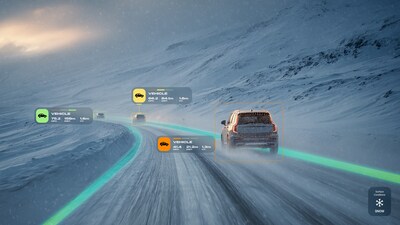
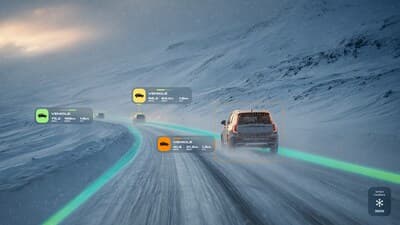
But take note: RFIC yield at 0.2 THz, radome material losses, thermal management of multi-GHz front-ends, and on-board compute for processing dense voxels at 30–60 Hz frame rates all add complexity. We need repeatable, quantified performance data—range to 10% reflectivity targets at 150–200 m in heavy fog, false-positive/negative rates below 5%, and velocity accuracy under 0.1 m/s. Until we see that, the physics remains formidable.
Industry Context: Where Terahertz Fits
OEMs are racing to bolster ADAS performance in poor weather, driven by safety ratings (NCAP’s night/adverse-weather tests) and customer expectations. Current sensor trade-offs are well understood:
- Cameras: affordable, high resolution in clear conditions, but fail in glare, low light, or fog.
- Lidar: excellent resolution, reliable range measurements, yet expensive and performance degrades in heavy mist or rain.
- Imaging radar: robust in all weather, but until recently lacked the point density to rival lidar; 4D imaging radars are closing that gap.
- Thermal cameras: useful for detecting warm objects in glare, but don’t provide direct depth measurements.
A credible terahertz sensor could let automakers reduce the number of front-facing lidars in mainstream trims—substituting one $700 unit with a few hundred-dollar THz sensor—while improving coverage in fog and spray. That said, both imaging radar and lidar ASPs (average selling prices) continue to drop, and fusion algorithms are getting smarter. Teradar will need clear, quantitative advantages on range, resolution, and reliability to displace existing roadmaps.
Automotive Readiness: The Real Work
To hit a 2028 model-year deployment, Teradar and its Tier 1 partners must cross several rigorous automotive milestones:

- ISO 26262 functional safety up to ASIL-D for braking/steer-by-wire use cases.
- AEC-Q qualification for RFICs to ensure reliability under temperature, vibration, and mechanical stress.
- PPAP (Production Part Approval Process) under IATF 16949 for consistent manufacturing quality.
- ISO/SAE 21434 cybersecurity compliance for safe operation in connected vehicles.
- EMI/EMC testing and DVP&R (Design Validation Plan & Report) across –40 °C to 125 °C, IP6K9K ingress protection, and shock/vibration profiles.
- Global homologation: early coordination with FCC/ETSI (U.S./Europe) and China’s MIIT for emissions above 95 GHz.
Each step typically takes 12–18 months. Rarely does an entirely new sensor chemistry sail through on first try. Expect schedule slippage unless Teradar aggressively parallelizes design-in with multiple Tier 1s and OEM validation programs.
What This Means for OEMs & Operators
Assuming targets are met, an OEM could reconfigure its sensor architecture on mid-trim vehicles:
- Replace one front-facing lidar with a single terahertz unit plus existing imaging radar and stereo/mono cameras.
- Save an estimated $300–$800 in hardware costs per vehicle (scenario-dependent).
- Boost up-time of key ADAS features (adaptive cruise, collision avoidance) in fog, mist, and spray.
- Reserve high-end lidar for edge scenarios—mapping, long-range pilot, and critical object classification.
For level 3 pilot programs, terahertz could serve as an adverse-weather backbone sensor, with lidar and radar providing cross-checks. Sensor fusion pipelines must be adapted to handle a new data modality—raw THz voxels vs. object-level tracks—and compute budgets must accommodate multi-Gbps data paths and 10–20 W average power draw.
Risks & Unknowns
- Range & Weather Performance: Verified detection distances on low-reflectivity targets (e.g., dark tires, road signs) in rain/fog are the pivotal metrics. Water vapor absorption and wet, dirty radomes could erode range by 20–50%.
- Compute & Power: High-resolution sensing translates into large data streams; the integration burden and cooling requirements may offset sensor cost savings.
- Manufacturing Yield: Sub-THz RFICs, advanced packaging, and antenna array assembly risk early yield issues and cost variability.
- Regulatory Pathways: Emission limits above 95 GHz exist but productized certifications for THz are less mature, potentially adding 6–12 months to timelines.
- Timeline Risk: A 2028 MY launch is aggressive. Running parallel programs with lidar or next-gen imaging radar is prudent until PPAP is secured.
Recommendations for a Structured Evaluation
- Plan a 2025 field trial across diverse conditions (clear, glare, rain, fog, spray) with standardized thresholds: 10% reflectivity detection at 150–200 m, sub-5% false positives/negatives, latency below 50 ms, and velocity error under 0.1 m/s.
- Clarify Data Interfaces: Confirm whether Teradar supplies raw point clouds or object-level data, and ensure your compute architecture can handle peak multi-Gbps throughput and a 5–15 W power budget.
- Early Enclosure Design: Select low-loss radome materials (TPX, HDPE) and perform contamination, heating/defogging, and washer-jet tests to mimic real-world wear.
- Certify Emissions & Safety: Align with FCC, ETSI, and MIIT on THz emission pre-compliance; document safety justifications (non-ionizing radiation, exposure limits) to streamline homologation.
- Stage-Gate Procurement: Negotiate early design-in contracts with off-ramps; maintain parallel options with lidar or imaging radar to preserve leverage and continuity through 2027.
Conclusion
Teradar’s terahertz sensor ambition is compelling: radar-like cost and durability with lidar-level clarity in all weather. Yet the physics hurdles, certification gauntlet, and manufacturing scale-up will determine whether this becomes a mainstream lidar alternative or a niche supplement. Treat 2025–2026 as the critical validation window. If structured testing confirms performance and PPAP closes on schedule, a 2028 model-year rollout could reshape automotive perception stacks. Until then, keep lidar and advanced radar in your fold as you chart a path forward.