Executive summary – what changed and why it matters
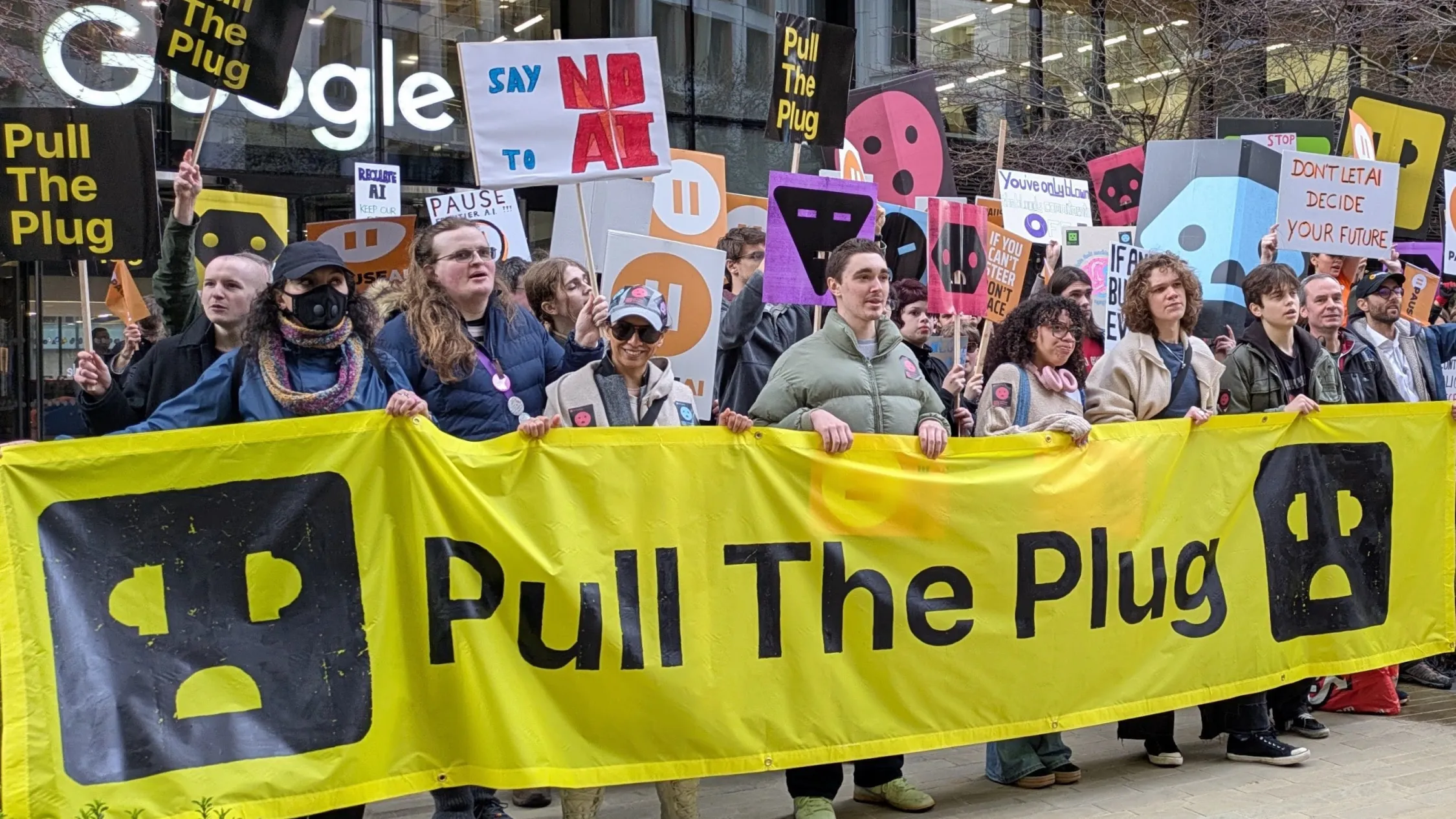
Public concern about AI has shifted from niche academic and policy debates to organized street‐level politics explicitly targeting major vendors and government policy. On Feb. 28, 2026, a coalition led by Pause AI and Pull the Plug brought together organizers, researchers, community groups and former industry workers for a march of a few hundred people—some outlets reported up to 500—through London’s King’s Cross district. Routing past OpenAI’s UK office on Pentonville Road and the headquarters of Google DeepMind and Meta, the protesters called for a global moratorium on frontier AI training, binding citizens’ assemblies and stronger whistleblower protections. That scale and geography mark a strategic departure from the handfuls of activists who gathered at academic panels in 2023 and the localized demonstrations of 2024.
The London march in focus
The demonstration began outside OpenAI’s UK office and proceeded to Google DeepMind and Meta, ending in a “People’s Assembly” inside a Bloomsbury church hall. Organizers named by outlets included Pause AI’s Joseph Miller—who noted that the first event in 2023 attracted just five participants—and Matilda da Rui of Pull the Plug. Additional groups such as Mad Youth Organise, Blaksox and Assemble took part, each highlighting themes from data‐center emissions to digital labor rights. Observers reported a heterogeneous turnout: safety researchers, tech workers concerned about job displacement, democracy activists and local residents affected by environmental impacts.
- Scale: Organizers and news outlets cited several hundred participants; one report from Awesome Agents estimated up to 500.
- Focus: The march combined near‐term grievances—misinformation, labor disruption, carbon footprints—with long‐term existential risk and opposition to military applications of large language models.
- Timing: The demonstration followed recent government pressure on AI firms over military access to LLMs and media reports of a tentative OpenAI–DoD arrangement, which some outlets say Anthropic resisted.
- Coordination: Parallel demonstrations were noted in Berlin outside the Federal Ministry for Economic Affairs, suggesting an emerging international network.
Why this shift matters now
Three converging factors appear to have amplified street‐level mobilization. First, rapid capability advances—particularly in generative AI—have made potential harms more visible to non‐specialists and amplified public anxiety. Second, recent policy debates in the UK and US over military use of AI models have drawn the technology into national security conversations, heightening the stakes for both regulators and vendors. Third, organizers report that international coordination and online outreach have accelerated growth: what began as isolated heckling outside academic events now commands hundreds on the streets of global tech hubs.

Protest materials circulated at King’s Cross cited an opinion survey claiming 84 percent of Britons fear that government tech partnerships may sideline public interests. Whether or not that statistic is independently verified, it signals how organizers aim to connect broader public sentiment to specific policy demands—ranging from moratoria on frontier‐model training to the establishment of enforceable citizens’ assemblies on AI safety.
Observable impacts on industry and policy
While it is too early to trace direct causal links between the Feb. 28 march and any new regulation, several diagnostic observations emerge about how street‐level politics may reshape the AI landscape:
- Regulatory risk amplification: The protest’s public framing of AI as a social and security concern coincides with louder calls—both in media and from some legislators—for statutory limits, suggesting that vendors face an increased likelihood of binding guardrails rather than voluntary codes.
- Recruitment dynamics: Organizers have framed efforts to “dry up” talent as a tactic to curb unfettered development, introducing a potential reputational dimension to hiring in high‐risk AI roles. Whether this narrative will deter prospective candidates or simply spur alternative recruitment geographies remains an open question.
- Reputational scrutiny: By targeting corporate headquarters and linking lab activities to environmental, social and existential harms, the movement has amplified reputational pressures that could affect stakeholder conversations with investors, customers and regulators.
- Policy window signaling: Coordinated street actions in London and Berlin may provide regulators with political cover to accelerate inquiries into military use and safety practices, particularly as public protests create media moments that policymakers seldom ignore.
Risks and caveats
Several uncertainties temper the interpretation of Feb. 28 as a definitive turning point. Crowd estimates range from “a few hundred” to roughly 500, so while the event marks a material increase, it falls short of mass mobilization. The coalition’s diversity—spanning credible AI safety researchers and groups with more speculative conspiratorial views—risks conflating mainstream governance concerns with fringe demands in the eyes of regulators or the public. Historical precedent from other technology protests suggests that turnout spikes do not always translate into sustained policy victories or binding regulation.
A historical and competitive lens
Compared with the handful of activists who gathered around AI panels in 2023 and the localized campus actions of 2024, the Feb. 28 march stands out in both scale and strategic targeting. By routing past major vendor offices rather than academic or conference venues, organizers signaled a shift from internal industry debate to direct pressure on corporate and government actors. In past technology controversies—from genetic engineering in the early 2000s to social media privacy in the 2010s—street‐level demonstrations have occasionally accelerated regulatory momentum, albeit often with a lag of months or years.
For vendors and policymakers alike, this event appears less a one‐off spectacle and more a signal of a maturing grassroots movement. Its explicit demands—ranging from global moratoria to citizens’ assemblies—align with parallel calls in legislative bodies, suggesting that public protest may soon dovetail with formal policy processes rather than remain on the margins.
Conclusion
The Feb. 28 London march represents a discernible step‐change: AI has crossed from academic conference halls into organized street politics. While turnout numbers remain in the low hundreds, the targeting of major corporate hubs and simultaneous actions abroad point to a broadening campaign. As public concern about AI continues to crystallize into direct political action, both vendors and regulators will find themselves operating under heightened scrutiny—one that blends social, environmental and security considerations in a single public arena.