Pocket detection tools shift power over public recording but bring technical, legal, and social tradeoffs
Thesis: Nearby Glasses — an Android app that scans nearby Bluetooth identifiers and alerts users to certain smart‑glasses hardware — demonstrates how consumer tools can redistribute power in public recording encounters, but it also exposes a set of technical, legal and social tradeoffs that complicate bystander privacy rather than resolving it.
What Nearby Glasses does and why it matters
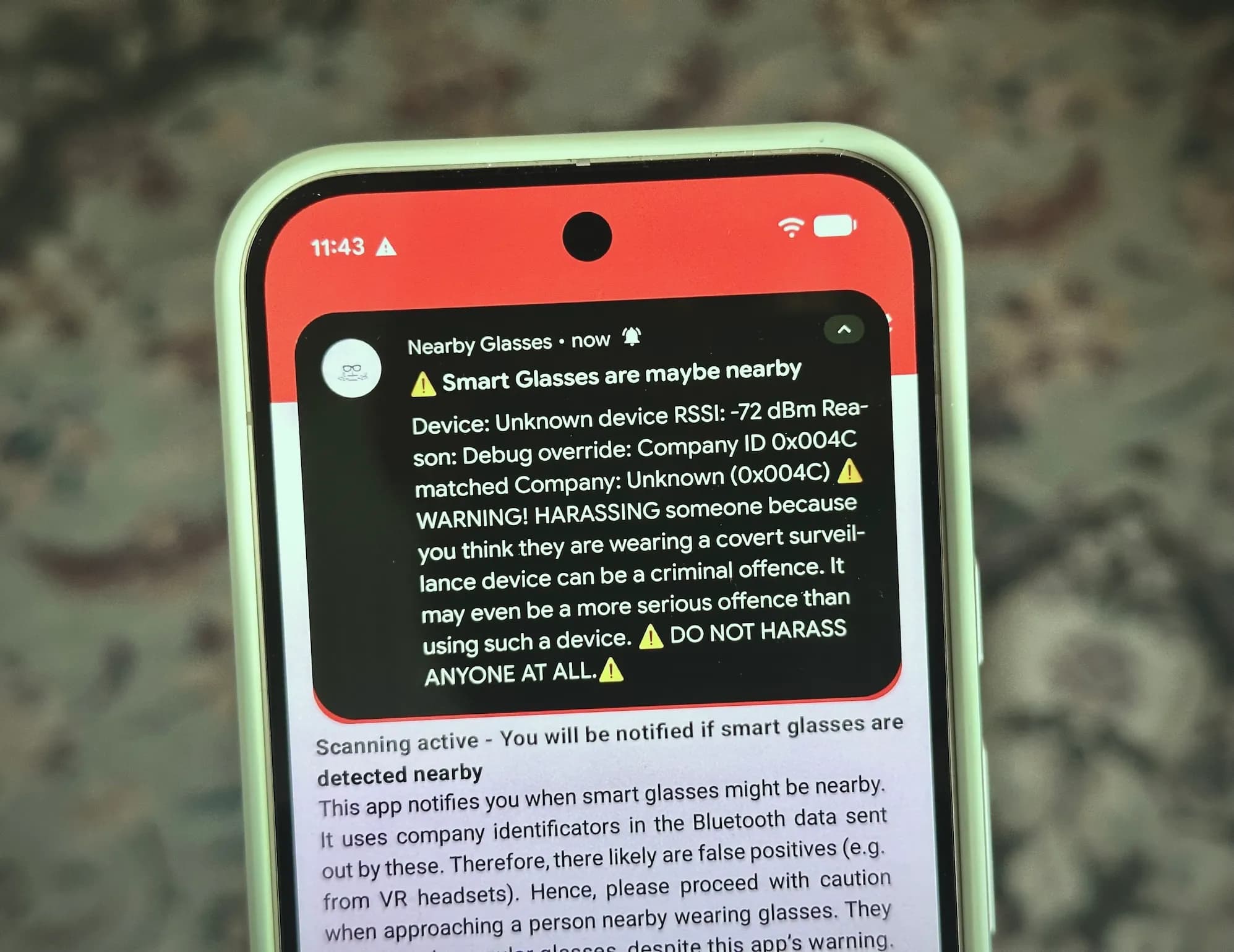
Nearby Glasses, available for Android as of March 2, 2026, listens for Bluetooth signals that include manufacturer-assigned identifiers and notifies users when those IDs match known smart‑glasses makers such as Meta or Snap. The app’s creator, Yves Jeanrenaud, has framed the project as a response to documented misuse of smart glasses; Jeanrenaud described it as a “desperate act of resistance.” Users can add custom Bluetooth identifiers to broaden the list of devices the app monitors.
The substantive change is not technical novelty so much as accessibility: detection moves from venue-level policies and hardware indicators into an object a bystander can carry in a pocket. That changes the locus of agency in public recording scenarios — giving individuals a way to learn about potential nearby wearable cameras — while also changing the incentives for manufacturers, regulators and malicious actors.
What the app claims — and what is unverified
The developer claims Nearby Glasses can detect Meta and Snap hardware by matching broadcast Bluetooth identifiers. There are no published independent accuracy tests or quantified false‑positive/false‑negative rates available; the reporting here is based on the developer’s descriptions and observable behavior of the app rather than third‑party validation. The developer has acknowledged known sources of false positives — notably Meta VR headsets — but has not provided measured error rates.

Technical limits that shape real‑world impact
- Detection depends on publicly broadcast Bluetooth identifiers. Manufacturers can change how they broadcast or adopt identifier randomization or encryption, which would reduce the app’s visibility into devices.
- Range and reliability vary with hardware, operating system Bluetooth stacks, environmental interference, and whether devices temporarily obfuscate or suppress identifiers.
- False positives — such as alerts triggered by VR headsets or other Bluetooth devices — create a risk that users will lose faith in alerts or experience unnecessary alarm in public spaces.
- Platform constraints matter: Android permits the background scanning patterns this app relies on more readily than iOS, which limits the app’s cross‑platform reach and shapes who can carry this form of detection.
Why this arrives now
The launch coincides with a wave of consumer and workplace smart‑glasses rollouts and trials across 2024–25, which has increased the frequency of bystander exposure to wearable cameras. That growth has intensified anxieties about unconsented recording, creating demand for tools that let people avoid or respond to perceived surveillance. Nearby Glasses is the most visible consumer attempt to translate that demand into a pocketable countermeasure to date.
Governance and market dynamics at stake
Nearby Glasses sits in a narrow early market niche with few apparent direct competitors at scale. That positioning creates two friction points. First, device manufacturers may view detection tools as a threat to their product design and could respond by changing identifier behaviors, adding encryption or contesting apps that rely on those identifiers. Second, app stores and platform owners will face pressure to weigh developer policies, privacy protections and potential abuse — including scenarios where the tool could be repurposed to assist stalking or to evade venue‑level monitoring.
Human stakes: agency, trust and power
The app reframes bystander privacy as a question of individual agency: a person carrying a phone can become informed about nearby recording-capable hardware and make immediate choices — to leave, to confront, or to document the encounter. That shift redistributes power away from only venues and device makers toward individuals. At the same time, it shifts burdens: individuals must assess alerts that may be imperfect, and marginalized people who most need protection from covert recording could face inconsistent benefits if detection is unreliable or if manufacturers change device behavior.

Operational implications and likely responses
This development raises several likely pressures across organizations and governance actors. Privacy and security teams will face a need to evaluate how pocket‑scale detection tools affect public‑facing operations, event screening and staff guidance. Legal and compliance teams will confront questions about the legality of device scanning in different jurisdictions and about how detection tools intersect with anti‑stalking laws. Product teams and industry groups will encounter incentives to negotiate or contest standards for visible recording indicators, and regulators may have to decide whether to protect bystander tools, restrict their use, or set boundaries that account for misuse risks.
Bottom line
Nearby Glasses turns an abstract bystander privacy problem into a tangible product, shifting the balance of agency in encounters with wearable cameras. That shift is diagnostic: it reveals conflicts of power and new tradeoffs rather than delivering a definitive fix. The app’s reliance on broadcast identifiers, the absence of independent accuracy testing, platform differences, and potential manufacturer or regulatory countermeasures all point to a future in which detection will be contested territory — technically, legally and socially.