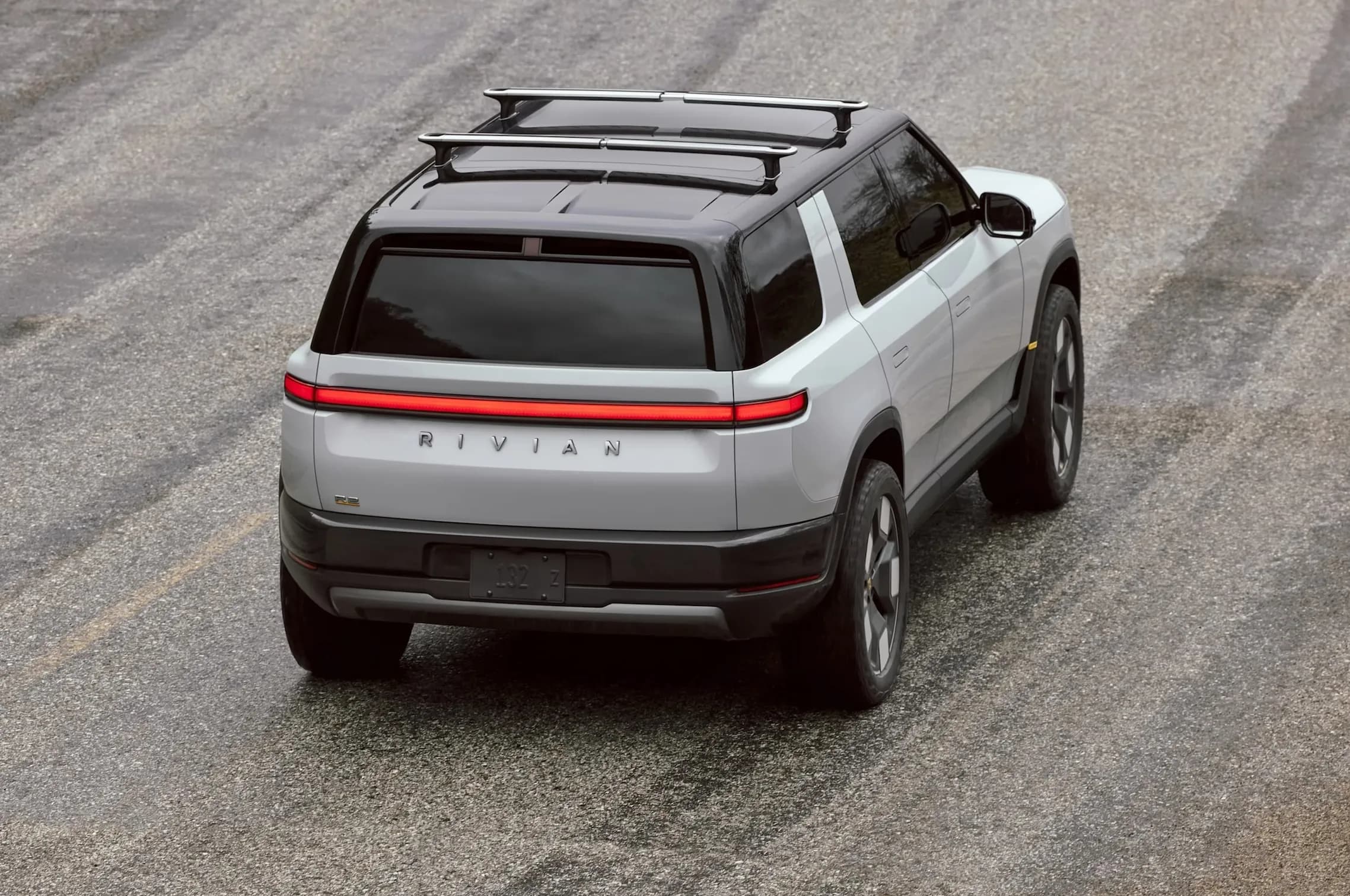
Executive summary
The R2 acceleration in Normal, Illinois compresses Rivian’s near-term survivability into a binary, time-boxed operational experiment: if the Gen-2 ramp fails to hit scale and quality targets by spring 2026, the company faces renewed investor pressure and strategic retrenchment; success would unlock much-needed unit economics validation.
Key takeaways
- Production acceleration: Management has funded an 11-month, $1.5 billion expansion (2.6 million sq ft) at Normal, IL to begin Manufacturing Validation Builds (MVBs) in January 2026 and target spring 2026 volume output.
- Scale leap vs. legacy output: The expanded plant is projected to reach 155,000 annual R2 units at capacity compared to approximately 42,000 total vehicles produced by Rivian in 2025—an unverified production surge that hinges on ramp reliability.
- Cost-reduction claims if realized: Management asserts the Gen-2 architecture can lower per-unit costs by ~$31,000 and attributes $170 million in Q4 2024 gross profit to early R1-to-Gen-2 transitions; these figures remain unverified at scale.
- Spec-driven positioning under review: Pre-production data cite up to 656 hp, 300+ mile range, 0-60 mph in 3.6 s, and native NACS charging; the announced price band is said to compete with the Tesla Model Y at roughly $45,000.
Breaking down the announcement
In March 2026, Rivian confirmed it has compressed its U.S. Gen-2 launch timeline by pivoting from a planned Georgia start to an 11-month Normal, IL buildout. According to management, 95% of R2 sourcing is complete, with engineering validation ongoing. MVBs rolled off the line in January 2026, signalling an aggressive schedule that outpaces initial projections for 2025 launches.
The company describes the Gen-2 platform as a “simplified” architecture with fewer parts than R1, aimed at streamlining assembly and reducing complexity. Management claims these design efficiencies drove an estimated $31,000 cut in per-unit cost and credited early R1-to-Gen-2 integration with a $170 million gross profit contribution in Q4 2024—claims that, if realized at volume, would mark a significant inflection in Rivian’s unit economics.
Alongside manufacturing, Rivian highlights ecosystem expansion: 71 service centers and approximately 600 mobile service vans to date, with about 30 more centers projected by 2025. The firm is also upgrading its compute stack for autonomy (11 cameras, five radars, 200+ TOPS), though detailed validation of these systems remains pending formal safety testing and regulatory certification.
Operational and financial trade-offs
The rapid scale-up presents a classic trade-off: pushing capacity ahead of proven processes risks elevated defect rates, warranty costs, and potential recalls. Management frames the Normal buildout as a necessary gamble to reach full capacity of 155,000 R2s—nearly four times Rivian’s total 2025 volume—in less than a year. If ramp reliability falters, the company could see margin compression that erodes investor goodwill.
Conversely, meeting volume targets on time with acceptable quality would validate the Gen-2 cost-reduction thesis and accelerate revenue recognition. Early gross-margin disclosures for Q1 2026 deliveries will become pivotal barometers for whether the platform’s simplified architecture delivers on its promise, or whether hidden integration costs emerge at scale.

From a capital-allocation standpoint, management’s focus on the R2 roll-out effectively defers large-scale R3/R3X investments until the Normal experiment proves out. The stakes are existential: a smooth ramp could restore confidence in management’s execution capabilities, while persistent delays risk a re-pricing of Rivian’s valuation and tighter funding terms.
Platform architecture and cost implications
The Gen-2 platform’s modular design aims to consolidate powertrain, battery, and electronics under a common architecture. Management claims that component count has been reduced by an unspecified percentage versus Gen-1, yielding the touted ~$31,000 cost saving per unit. If that figure holds true in volume, Rivian would achieve leverage comparable to more mature EV players—a critical milestone after prolonged R1 cost overruns.
However, the cost-reduction claim remains unverified outside management’s statements. Independent benchmarking of battery module yields, EV-specific subassembly times, and end-of-line validation throughput have yet to emerge in public filings. Until such data are disclosed, the claimed unit-cost delta should be regarded as “management asserts” rather than a realized performance metric.
On the revenue side, price positioning near the Model Y—if sustained—could capture a share of mainstream EV demand at a lower development base. But selling prices (ASP) in Q1 2026 deliveries will be a critical reliability check on whether Rivian can command the targeted price band once dealer- and incentive-weighted transactions are tallied.
Service network and ecosystem readiness
Rivian’s push to expand service centers and mobile-service capacity reflects a recognition that post-delivery support can make or break early adopters’ experiences. The company reports 71 fixed-location centers and 600 mobile vans in operation, with plans for ~30 more centers by 2025. If capacity scales as stated, Rivian could mitigate quality fallout—though ramping new service locations in tandem with the R2 roll-out may itself strain operational bandwidth.

Autonomy and software updates are also billed as upgradeable over the air, backed by 11 camera feeds, five radar sensors, and a cumulative 200+ TOPS compute stack. These numbers echo the industry’s push toward fleet-data-driven safety enhancements, but formal crash-test and regulatory approval timelines for Gen-2 hardware remain to be disclosed. Real-world incident reports and ADAS incident metrics will be necessary to substantiate any advanced-driving claims.
Implications for stakeholders
- Investors and board members are likely to treat Q1 2026 delivery volumes and reported margin metrics as a pivotal inflection; underperforming figures could trigger reassessments of future funding rounds and governance scrutiny.
- Operational teams face an elevated risk profile: supplier delays or workforce shortages during the 11-month build could cascade into quality issues, affecting warranty reserves and brand reputation.
- Regulators and safety advocates will focus on formal crash and range-test outcomes; any deviations from stated performance metrics may prompt increased oversight of ADAS and OTA update practices.
- Industry competitors will view the R2 ramp as a live benchmark: a successful fast-launch could raise the bar for EV factory cycle times, while a faltering roll-out would validate more cautious, phased production strategies.
- Component suppliers face volume commitment uncertainty: failure to meet Normal plant targets could lead to underutilized capacity and pressure to renegotiate supply contracts.
Risks and caveats
- Ramp-rate quality risk: Accelerating to 155,000 annual units within months increases the probability of hidden defects; early warranty claims and recall notices will reveal true build integrity.
- Cost-reduction uncertainty: The ~$31,000 per-unit saving is an unverified management assertion; actual realized savings will depend on yield, scrap rates, and labor efficiency at scale.
- Validation shortfalls: MVBs do not equate to full fleet certification—official safety and range tests, regulatory filings, and third-party crash data remain outstanding.
- Supply-chain strain: Synchronized supplier deliveries of battery cells, castings, and electronics in under a year risks material shortages or logistics backlogs, potentially delaying volume output.
- Competitive price pressure: Positioning near the Model Y price point may invite aggressive incentive matching, compressing ASPs and undermining margin assumptions if demand elasticity weakens.
Competitive context
Rivian’s strategy echoes Tesla’s historical rapid-ramp playbook, but the assertion of “one of the fastest U.S. EV launches” remains unverified against previous Model 3/Y cycles—external benchmarking of cycle time would be required for confirmation. Unlike incumbents with multigenerational factories, Rivian must simultaneously prove new architecture, new factory, and new service network in a compressed timeframe.
If the Gen-2 platform delivers on cost claims and throughput scales as stated, Rivian may join the upper echelon of volume EV makers. But any misalignment between projected and actual performance will likely intensify scrutiny on management’s operational discipline and could erode goodwill among prospective customers and investors alike.
Next signals
Key metrics to monitor in the coming weeks include Q1 2026 delivery and ASP disclosures, reported warranty reserve movements, and official crash and range-test certifications for R2 MVBs. Publicly posted incident reports or recall bulletins will also serve as early indicators of build quality. Community sentiment—while showing anecdotal enthusiasm on RivianForums and social media—remains unverified until hard data on uptime and service turnaround times are published.