Executive summary — what changed and why it matters
The conviction of Oleksandr Didenko underscores how identity‐theft rings have embedded state-backed operators into U.S. companies by exploiting remote-work ecosystems, signaling an inflection point in enforcement of sanctions, data-security, and identity verification.
- Immediate impact: This 60-month sentence and the May 2024 seizure of the Upworksell.com domain mark a demonstrable escalation in U.S. enforcement against hybrid schemes involving identity theft, sanctions evasion, and intellectual-property theft.
- Operational risk: Organizations that rely heavily on freelance marketplaces and remote-hiring processes are being identified as primary vectors for state-backed intrusion and financial channeling.
- Compliance angle: Department of Justice filings, OFAC guidance, and recent FinCEN and SEC pronouncements together suggest that sanctions, criminal-forfeiture, and suspicious-activity reporting frameworks will be applied more rigorously to contractor payments and identity-verification processes.
Breaking down the announcement
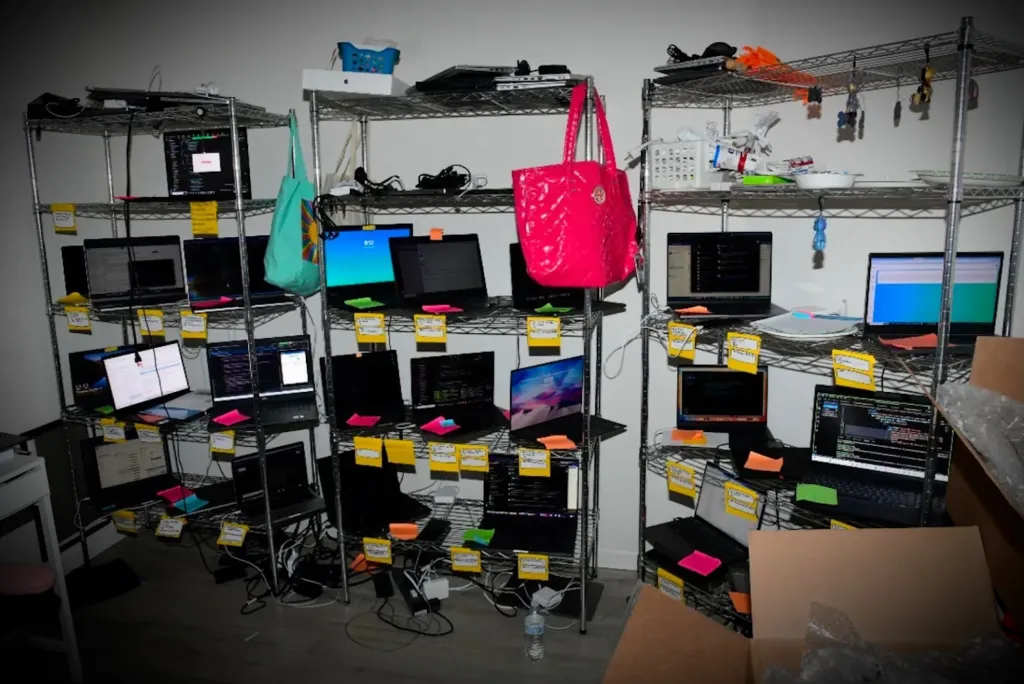
On February 20, 2026, a U.S. federal court imposed a 60-month prison term on Oleksandr Didenko, a 29-year-old Ukrainian national who operated Upworksell.com, a marketplace prosecutors say facilitated the sale or rental of over 870 stolen U.S. identities. According to Department of Justice filings, the Federal Bureau of Investigation seized the site infrastructure in May 2024 and rerouted incoming traffic to undercover servers for evidence collection. The filings allege that Didenko enlisted U.S. residents to host “laptop farms”—rows of perpetually powered-on laptops in California, Tennessee, and Virginia—creating the appearance of domestic freelancer activity while routing earnings through stolen identities.
Prosecutors allege that Didenko’s network generated thousands of fraudulent freelance accounts on platforms resembling Upwork and similar technology-service marketplaces. These accounts, created under appropriated identities, bid on software-development, data-analysis, and IT-support contracts. Wages purportedly earned by those accounts were wired—often in multiple legs of domestic and offshore transactions—to bank accounts tied to entities benefitting North Korea’s nuclear and ballistic-missile programs.
Public security vendors, including reports attributed to CrowdStrike and other industry observers, have documented a recent uptick in North Korean threat actors posing as remote contractors. The Didenko case reflects a convergence of identity theft, sanctions evasion, and potential extortion through stolen corporate secrets, delineating a triad of emerging risks.
Why now — enforcement and risk context
This sentencing follows a series of related actions initiated by U.S. and allied law-enforcement agencies aimed at dismantling North Korean “IT worker” operations. In 2024 alone, the FBI and allied partners executed multiple domain seizures linked to similar schemes. The Department of Justice has characterized these activities as a “triple threat” that simultaneously undermines sanctions regimes, enables corporate espionage, and supplies leverage for extortion demands.

Regulatory bodies have concurrently updated guidance on third-party risk and contractor payments. FinCEN’s 2025 advisory on sanctions evasion highlighted the misuse of stolen identities to circumvent anti-money-laundering controls. The SEC’s cyber-incident disclosure guidance, effective late 2025, explicitly cites supply-chain infiltration and fraudulent contractors as reportable events when material systems or data are impacted. These developments indicate a broader shift toward integrating remote-work security into mainstream compliance and audit workflows.
The Didenko case surfaces at a juncture when remote and hybrid hiring models are deeply embedded across technology, finance, and professional-services sectors. Freelance platforms have grown into multimillion-user ecosystems, and the reliance on digital identity verification has heightened systemic exposure to fraud. As a result, enforcement priorities are adapting to view these platforms not just as labor marketplaces but as potential conduits for state-sponsored cyber operations.
Operational implications — emerging patterns
- Identity-verification gaps: According to DOJ filings, stolen identities routinely passed standard applicant-tracking systems and social-media background checks. Security vendors have noted that basic credential checks—email confirmation and LinkedIn profile reviews—may be insufficient to identify synthetic or hijacked identities.
- Laptop-farm infrastructure: The use of domestic, always-on endpoints in residential settings was observed to evade simple geofencing controls. Industry analysts have highlighted that endpoint-detection and response (EDR) telemetry—specifically, patterns of sustained RDP sessions and unusual process-spawn events—can reveal the persistence mechanisms underlying such farms.
- Payment-flow tracing: In this scheme, routing payroll and freelance earnings through stolen identities created layers of domestic financial activity that obscured ultimate beneficiaries. Suspicious-activity reports (SARs) filed by financial institutions in late 2024 indicated a spike in low-value, high-frequency transactions originating from known freelancer platforms.
- Data exfiltration and extortion: Prosecutors allege that once embedded, North Korean operators harvested proprietary code, internal documentation, and client data, which industry observers say can be repurposed for extortion demands or further espionage. Prior investigations show that combined legal and forensic response strategies have been mobilized to address these hybrid threats.
Comparison to prior schemes
Unlike traditional Lazarus-style malware or cryptocurrency-theft campaigns, the Didenko operation industrialized identity-theft and mixed domestic infrastructure with overarching sanctions evasion. Security vendors reporting on the trend have positioned these schemes alongside nation-state extortion operations, noting that the primary monetary objective serves to fund sanctioned programs rather than drive individual profit.

Earlier cases—such as the 2018 domain seizure of a North Korean cryptocurrency mixer—centered on direct financial fraud. In contrast, the Upworksell model layered financial transactions beneath seemingly legitimate freelancing activity, complicating detection efforts. The reliance on U.S.-based endpoints for remote access also diverged from earlier reliance on overseas virtual private servers, raising the operational threshold for attribution and takedown.
Governance and investigative pressures
Department of Justice filings tie this scheme to both OFAC and criminal-forfeiture statutes, creating parallel enforcement tracks. Sanctions-compliance teams are likely to reference these filings when evaluating third-party contractors and global hiring policies. In addition, FinCEN advisory notices issued in late 2025 identified similar identity-based evasion techniques as red flags for enhanced due diligence. The SEC’s expanded definition of cyber incidents includes supply-chain compromises that involve fraudulent contractor identities.
Corporate legal and risk teams have observed that subpoenas and grand-jury requests in related cases frequently cite internal collaboration logs, payroll records, and domain-registration data. Law-enforcement coordination—spanning the FBI, OFAC, and Treasury’s Office of Intelligence and Analysis—is now routinely invoked when cross-border infrastructures are implicated.

Common industry responses
In the aftermath of the Didenko conviction and similar cases, organizations and service providers have begun to adopt layered identity-assurance frameworks. Retrospective audits of remote hires since 2021 were observed to uncover compromised credentials in a portion of reviewed accounts. Security vendors have published rule sets for next-generation EDR platforms designed to flag inappropriate patterns of continuous endpoint availability and anomalous development-tool usage.
Financial institutions, per published SAR trends, have enhanced transaction-monitoring algorithms to include freelance-platform identifiers and to correlate incoming wires with contractor-onboarding data. Compliance officers interviewed in industry forums noted an uptick in requests for contractor-sanctions attestations, though the effectiveness of attestations without technical controls remains under evaluation.
Conclusion
The Didenko case illustrates a critical evolution in remote-work threat landscapes: the fusion of identity theft, sanctions evasion, and corporate espionage under the guise of freelance operations. As the workforce continues to decentralize, organizations risk becoming unwitting participants in state-backed cyber schemes. The conviction serves as a diagnostic marker that enforcement agencies are treating digital-identity fraud and remote-work infiltration as matters of national security, with broad implications for corporate governance, compliance frameworks, and the fundamental trust in digital labor marketplaces.