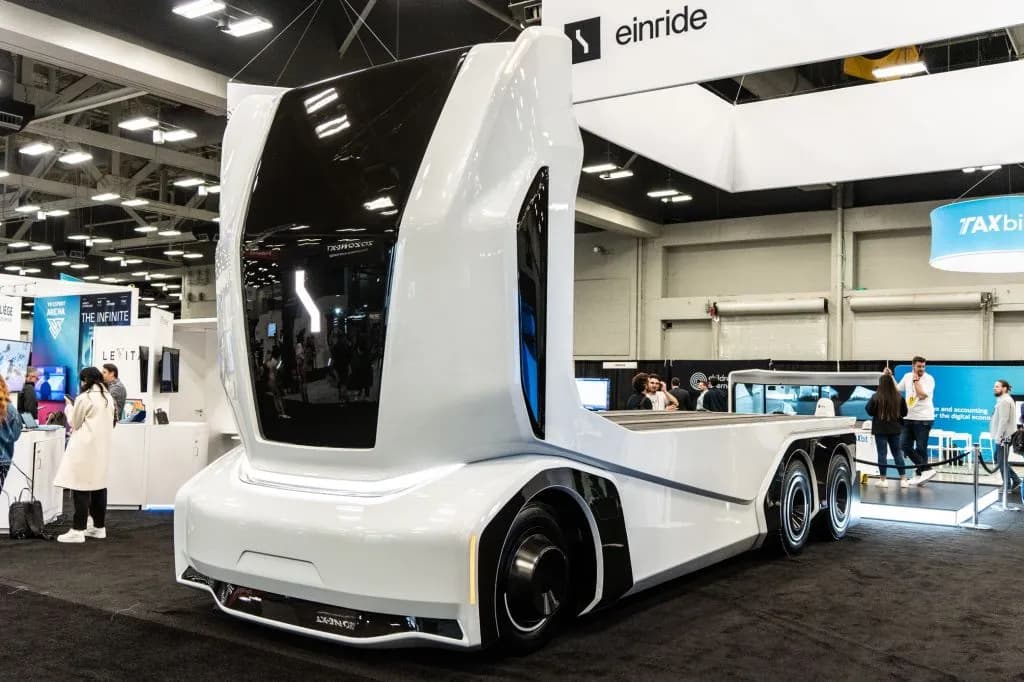
Einride’s oversubscribed PIPE reveals investor faith but makes scaling contingent on SPAC mechanics and operational proof
Thesis: The oversubscribed $113M PIPE demonstrates continued institutional appetite for Einride’s EV‑first and autonomy ambitions, but the reduced pre‑money valuation and SPAC redemption/governance dynamics mean that the newly pledged capital is necessary but not sufficient—outcomes for customers, partners, and investors will hinge on near‑term operational validation and how much cash survives the SPAC close.
Executive summary — what changed and why it matters
Einride announced an oversubscribed $113 million PIPE on Feb. 26, 2026, lifting projected gross proceeds for its planned NYSE listing via Legato Merger Corp. to about $333 million before redemptions and expenses. The round exceeded an initial $100 million target and follows a previously disclosed $100 million crossover financing. At the same time, Einride’s pre‑money valuation was reduced to about $1.35 billion from the earlier $1.8 billion disclosed during the SPAC process.
- Impact: The aggregate capital package increases the company’s headline cash available to fund battery electric truck deployments and limited autonomous pods across Europe, North America and the Middle East, though net operational runway will be lower after transaction costs and any public redemptions.
- Signal: PIPE oversubscription points to persistent institutional interest in EV/autonomy logistics even as the SPAC market remains cautious compared with 2021-era valuations.
- Constraint: The valuation haircut and familiar SPAC risks—notably redemption risk and post‑close governance and disclosure—make the path from committed capital to scaled revenue contingent rather than guaranteed.
Breaking down the financing
Public coverage reports that the $113M PIPE includes both new and returning investors, named sources point to players such as EQT Ventures alongside an unnamed West Coast asset manager. When combined with Legato’s trust (roughly $220M) and the previously announced $100M crossover round, Einride and Legato project about $333M in gross cash at closing, with the companies also indicating that additional capital could be sought prior to closing.

How much cash actually makes it to operations
The headline $333M figure is a useful starting point for assessing financial flexibility, but the interaction of transaction fees, pro forma adjustments and SPAC redemptions means net proceeds available for scale will be meaningfully lower in many scenarios. That gap is the central constraint linking the financing event to real‑world operational choices: headline capital can fund expansion on paper, but the degree to which it does depends on the mix of guaranteed PIPE commitments versus variable public investor behavior at the time of closing.
Operational footprint and where validation matters
Einride operates on the order of 200 heavy‑duty electric trucks across regions including Europe, North America and the UAE, and has run limited autonomous “pod” pilots with customers such as Apotea in Sweden and GE Appliances in the U.S. Commercial clients named in prior filings and coverage include Heineken, PepsiCo, Carlsberg Sweden and DP World. Those deployments are commercially active but geographically constrained pilots rather than widely scaled, driverless freight networks.

Market context: between 2021 SPAC exuberance and later retrenchment
The deal sits between two poles: it is neither a 2021‑style, frothy AV valuation nor a collapsed financing. Compared with earlier SPAC entrants that saw post‑debut retrenchment and governance challenges, Einride’s smaller valuation and an oversubscribed institutional PIPE create a middle path—more modest expectations paired with a tangible base of committed capital. That structure changes the balance of incentives for buyers and partners: the company appears more likely to be able to fund staged commercial rollouts, but the scale and timing of those rollouts remain conditional on demonstrable unit economics and regulatory progress across jurisdictions.
Risks and governance mechanics
Familiar SPAC mechanics remain the primary structural risk. Public shareholder redemptions can materially shrink closing cash, and Legato’s governance, disclosure and pro forma assumptions in SEC filings will shape how stakeholders update their expectations. Regulatory complexity across North America, the EU and MENAT adds jurisdictional friction to autonomous rollouts. Taken together, these factors mean that investors and customers are likely to treat the financing as a de‑risking step rather than a guarantee of rapid scale.

Implications for stakeholders (diagnostic)
- Finance and investors: The PIPE’s oversubscription reduces the odds of a cash shortfall at close, but the valuation haircut and redemption variability increase the probability that analysts and corporate treasuries will model multiple closing scenarios rather than assume headline proceeds.
- Logistics buyers and procurement teams: The capital raise raises the likelihood that Einride can sustain regional pilot programs and incremental contractual rollouts over the next 12–24 months, while leaving open the pace at which those pilots convert to broad, nationwide services.
- Partners and suppliers: The financing signals continued market confidence, which is likely to sustain existing supplier and partner engagement—yet it also elevates the emphasis on short‑term deployment metrics and regulatory milestones as the primary paths to deeper integration.
- Competitors: Einride’s position—an operational EV fleet operator with nascent autonomy pilots—reinforces competitive dynamics where capital commitment matters less than demonstrated unit economics and repeatable commercial contracts.
Bottom line
Einride’s oversubscribed PIPE is a meaningful vindication of institutional interest in EV‑first logistics, but the financing event does not eliminate core SPAC‑era contingencies. The decisive variable going forward will be operational proof points—fleet economics, regulatory approvals, and the proportion of headline capital that survives redemptions—because those are the levers that convert committed capital into durable revenue, market share and governance credibility.