Commercial autonomy and consumer satcom have shifted narco-smuggling’s human risk ashore, undermining maritime enforcement
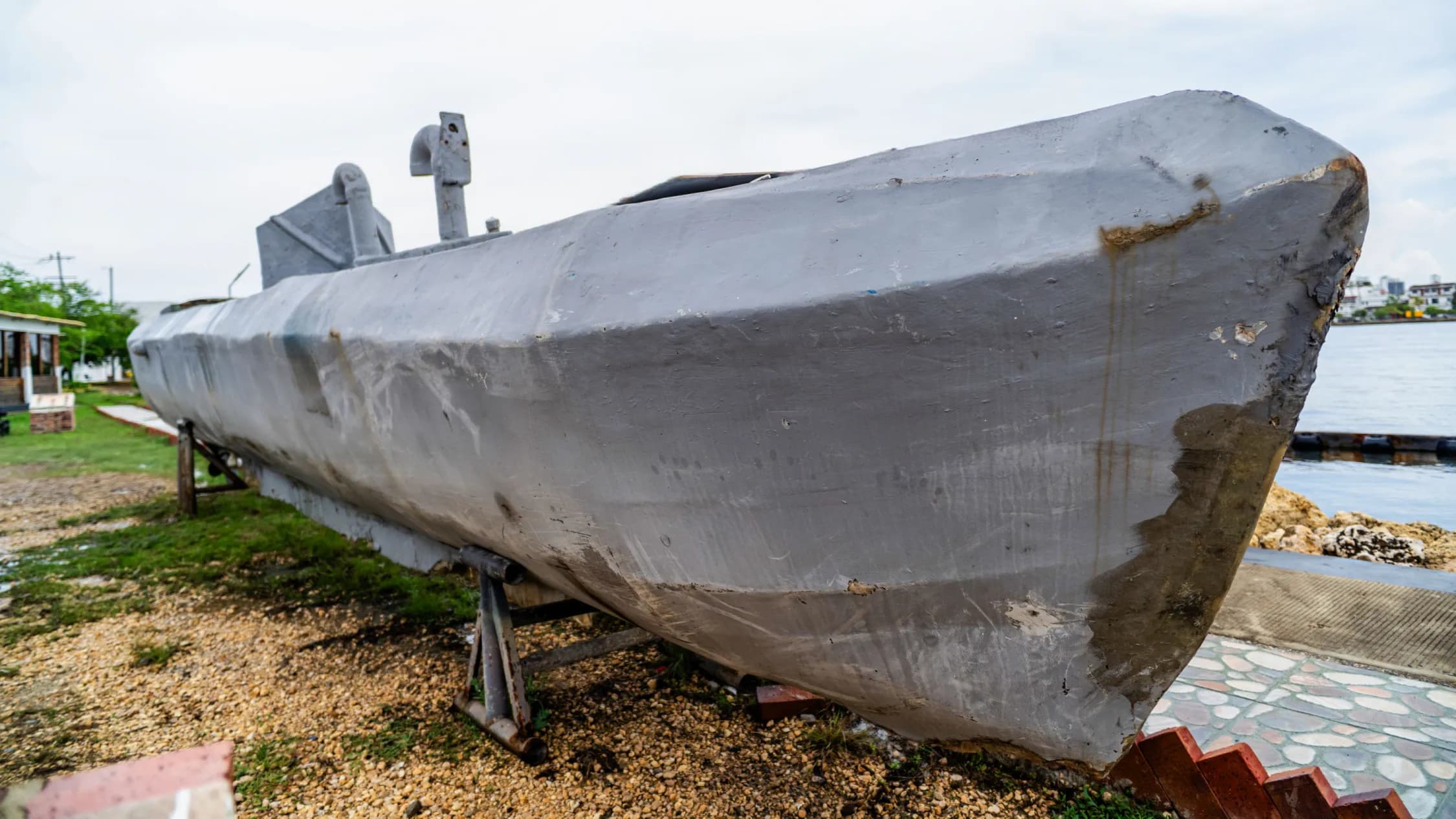
The seizure off Tayrona National Park confirms a structural change: cheaply available autopilots, high‑bandwidth consumer satellite terminals and compact cameras now allow traffickers to remove people from long‑range maritime smuggling runs, transferring risk to remote operators and eroding authorities’ ability to detect, attribute and prosecute at sea.
Executive summary — what changed and why it matters
Colombian inspectors recovered a roughly 40‑foot low‑profile semisubmersible that investigators concluded had no crew and was fitted with fuel, cameras, two consumer LEO satellite terminals and a commercial marine autopilot. Officials assessed fuel sufficient for on the order of hundreds of nautical miles and a cargo bay sized for roughly one to one‑and‑a‑half metric tons. Those elements together demonstrate that components available on open markets can be integrated into remote or semi‑autonomous smuggling platforms. The change is structural: it shifts violence, coercion and legal exposure away from onboard crews and toward dispersed procurement networks and remote controllers, with consequences for how states assert control over maritime space and hold actors to account.
Key takeaways
- Substantive shift: The intercepted craft is evidence that off‑the‑shelf autonomy and consumer satellite internet can be combined into a crewless delivery prototype, not merely an experimental novelty.
- Power transfer: Removing crews transfers physical danger and arrest risk ashore, altering who bears the human costs of smuggling and who can be punished.
- Operational reach: Investigators’ fuel and volume estimates imply endurance and payloads that make longer transits and loitering feasible—changing route geometry and rendezvous tactics.
- Attribution friction: Remote control plus commercial satcom complicates the chain linking a recovered hull to decision‑makers and financiers, creating new evidentiary and jurisdictional gaps.
- Market logic: Low unit cost of navigation and comms hardware compresses the Barriers‑to‑entry for maritime autonomy, reconfiguring incentives across supply chains.
Breaking down the seizure — concrete details and limits
The craft described by inspectors combined a fiberglass low‑profile hull, diesel propulsion and pumps, an electronics rack with a commercial NAC‑3–class autopilot, external and internal camera feeds, and two rectangular LEO‑style satellite terminals. Authorities reported no helm station or accommodations for crew. Their assessment of fuel and cargo volume implies endurance and payloads that differ from classic crewed semisubmersibles: autonomy trades the space and weight used by human accommodations for fuel and potentially more cargo, while eliminating the most visible human vulnerability—crews who can be interdicted, questioned, or coerced into revealing networks.
These equipment specifics are meaningful because they are not bespoke military components but commercial, widely available modules. The retail price point cited for the autopilot category is an order of magnitude below bespoke maritime systems, and consumer LEO terminals have proliferated marketing and distribution channels. That convergence makes rapid prototyping and iteration feasible for actors with procurement networks and technical intermediaries.

Why now — component availability, cost and incentives
The structural driver is commodification of autonomy and high‑bandwidth connectivity. Plug‑and‑play autopilots, compact satellite terminals and small high‑resolution cameras reduce the technical overhead of building a remotely controlled vessel. Where crewed runs impose persistent human costs—kidnappings, arrests, desertions—remote systems externalize those costs to a dispersed network of buyers, technicians and remote operators who are harder to locate and prosecute through traditional interdiction that focuses on people at sea.
Economics matter politically as well as financially. If a smaller crewless payload still yields large markups on international wholesale markets, the expected return per mission can justify experimentation with remote platforms. That alters cartel decision‑making: risk calculations about the value of human lives, the likelihood of interdiction, and the distribution of operational roles shift toward models that privilege remote oversight and reproducible hardware procurement.

Operational implications for enforcement, law and evidence
The shift to remote maritime platforms creates frictions for four core enforcement functions: detection, interdiction, attribution and evidence preservation. Detection technologies—radar, aerial patrols, thermal imaging—remain relevant, but a low‑profile semi‑submersible guided from shore complicates real‑time interdiction. Attribution becomes more complex because the decision‑makers and financiers can be separated by multiple intermediaries and cross‑border procurement chains. Evidence extraction is also different: salvage of onboard electronics may produce device IDs and activation records, but those records live on provider systems outside maritime custody and may be deleted, anonymized or tied to intermediaries rather than principals.
Legally, maritime doctrine and criminal statutes in many jurisdictions are not fully adapted to remote execution and scuttling from a distance. Forensic practices that rely on identifying crewmembers and their testimony lose potency when no crew exists. Chain‑of‑custody and digital‑forensics routines become central to proving intent and ownership, shifting prosecutorial reliance from human testimony to technical provenance.
Comparing options — where crewless subs sit in the ecosystem
Crewed semisubmersibles historically concentrated human risk and provided large payloads; go‑fast boats offered speed but exposed people to visible interdiction; container concealment relied on complex logistics and corruption chains. Crewless semisubmersibles insert a different tradeoff: lower human exposure, potentially longer endurance and stealthier profiles at the cost of increased reliance on remote communications and hardware supply chains. That trade reshapes the incentives of both traffickers and enforcement authorities, affecting where and how force, surveillance and legal instruments are applied.

Policy frictions and structural levers (diagnostic view)
Several structural frictions stand out as points of contestation between traffickers and states:
- Data and access: Consumer satellite terminals create off‑board records that could link devices to purchasers, but those records are held by private operators and exist outside immediate maritime custody.
- Procurement chains: Autonomy components travel through commercial supply chains—retailers, brokers, maritime outfitters—creating nodes where criminal use can be enabled without bespoke manufacturing.
- Legal mismatch: Existing evidentiary and maritime rules emphasize physical custody and human testimony more than remote command logs and cross‑border digital records.
- Surveillance scaling: Detecting low‑profile craft at range relies increasingly on sensor fusion and forensic readiness rather than only chasing people at sea.
These frictions reveal how power is being redistributed: traffickers gain operational resilience by outsourcing risk, while states face harder problems of long‑distance attribution, juridical reach and institutional coordination. The human stakes are consequential—lives that once filled hulls are now part of a dispersed apparatus of procurement and remote control, and the capacities of coastal communities, local enforcement, and national legal systems to hold accountable the actors who benefit from that reconfiguration are put under strain.
Conclusion — a structural warning, not an anomaly
The Tayrona interception looks less like a one‑off innovation and more like an early marker of a broader shift in maritime smuggling logistics. Where readily available autonomy and consumer satcom converge, organized crime can materially change who takes the risk, how operations are organized, and what evidence is available after interdiction. That shift reframes power relations in maritime illicit trade: moving danger off the water does not eliminate harm, it obscures and redistributes it across digital, legal and geographic boundaries.