Enterprise AI Power Is Moving From Model Builders to the People Who Control the Pipes
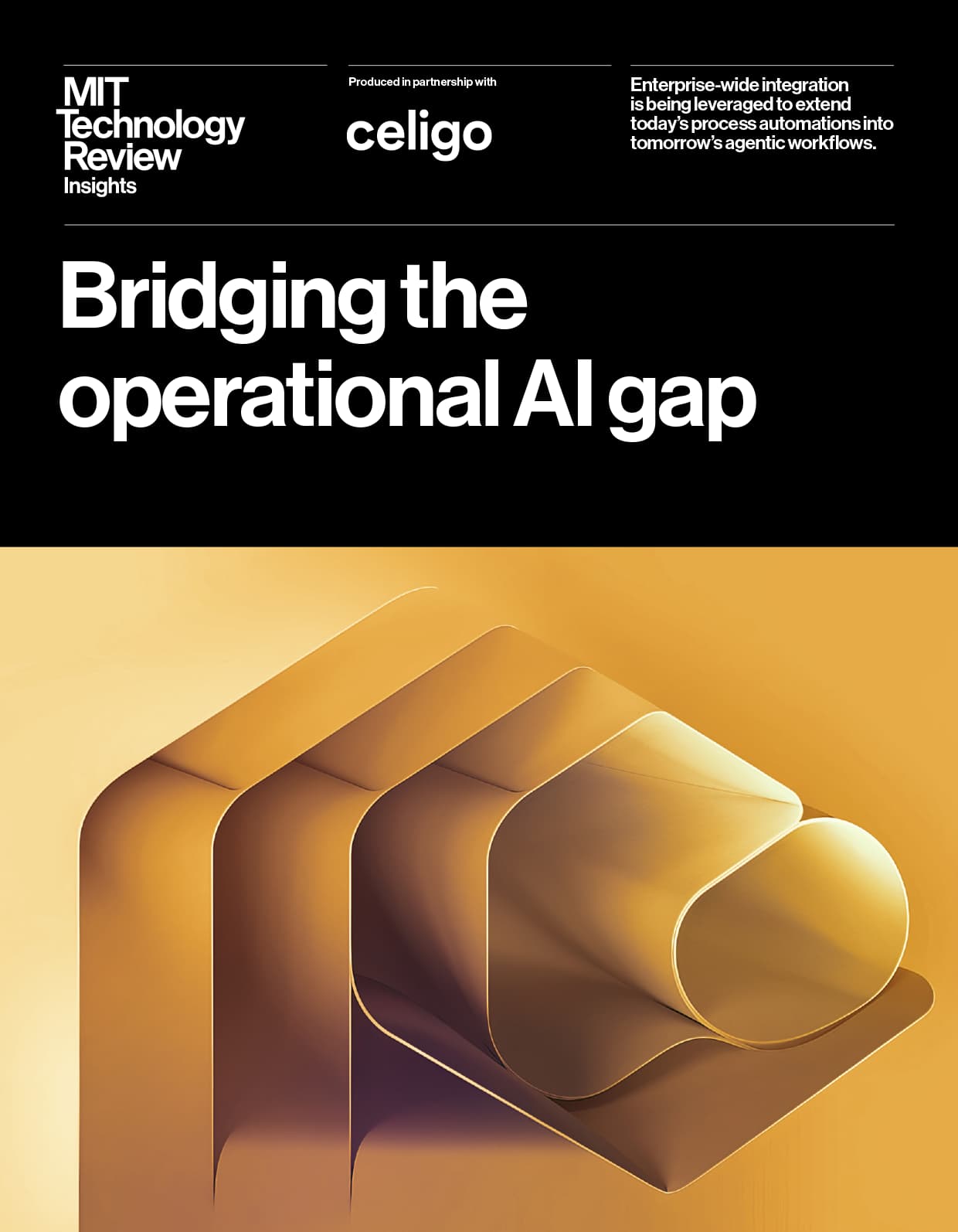
Enterprise AI is no longer waiting on better models; it’s waiting on better plumbing. New data from MIT Technology Review Insights shows that the organizations actually putting AI into production aren’t those with the flashiest pilots or biggest data science teams, but those with enterprise-wide integration platforms. As agentic AI gives workflows more autonomy, the locus of power quietly shifts from model builders and process owners to the people who design and govern these integration layers. They decide which systems connect, which data flows, and where autonomous agents are allowed to act. The more AI becomes embedded in those pipes, the less daily operational leverage individual humans have over how their organization actually runs.
The Evidence: Integration Platforms Map Where AI Can Actually Live
MIT Technology Review Insights surveyed 500 senior IT leaders at mid- to large-size US companies in December 2025, all of them already doing something with AI. The surface story is optimistic: 76% of these organizations report at least one department with an AI workflow fully in production. AI is no longer confined to whiteboard visions and small pilots; it is running, somewhere, inside most enterprises.
But “somewhere” is doing a lot of work. The survey shows that AI is most successful when applied to already well-defined, already automated processes: 43% of organizations report that their success comes from implementations attached to those kinds of workflows. Only a quarter say they’re succeeding with entirely new processes, and about a third (32%) say they’re applying AI across various types of processes. Structurally, AI is being grafted onto the most codified parts of the enterprise-places where integration is easiest and ambiguity is already low.
Meanwhile, the organizational scaffolding around AI is thin. Only 34% of respondents have a team specifically dedicated to maintaining AI workflows. The rest distribute the responsibility: 21% say central IT owns ongoing AI maintenance; 25% push it into departmental operations; 19% admit it’s simply “spread out.” This is not the picture of AI as a stable, specialist-owned discipline. It is AI dissolving into general infrastructure and local operations, often without a clear center of gravity.
The decisive split appears when the survey looks at integration platforms. Companies that have built an enterprise-wide integration platform are structurally different from those that either use integration only for specific workflows or not at all. Among the platform-centric group, 59% employ five or more data sources in their AI workflows. That drops to 11% for organizations that use integration tools only in isolated pockets, and to 0% for those without any integration platform.
Integration isn’t just correlated with richer data. The same group with enterprise-wide integration platforms shows more multi-departmental AI implementations, more autonomy embedded in AI workflows today, and more confidence in assigning greater autonomy in the future. AI in these organizations is not a single departmental experiment; it is an increasingly integrated operational layer crossing boundaries that used to be guarded by separate applications, teams, and approval chains.
Set that against Gartner’s forecast: by 2027, more than 40% of agentic AI projects are expected to be canceled due to cost, inaccuracy, and governance challenges. That is, the projects that aim to make AI workflows self-directing are running into the hard limits of messy infrastructure and missing governance. The MIT Technology Review Insights data suggests that where those limits are being overcome, it is not by better models, but by the existence of a shared integration substrate that lets those models actually do work across systems.
The content itself was produced by MIT Technology Review’s custom content arm, but the numbers are straightforward: without integration, AI remains fragmented, thinly deployed, and low in autonomy. Where integration platforms exist, AI becomes multi-system, multi-departmental, and increasingly self-directed. In other words, the map of the integration platform is becoming the map of where AI power can actually be exercised.
The Mechanism: Integration Turns AI from Tools into Infrastructure
The structural story underneath these numbers is simple and uncomfortable: once AI is wired into an enterprise-wide integration platform, it stops behaving like a tool and starts behaving like infrastructure. And whoever shapes that infrastructure holds disproportionate power over how AI is used, where it is trusted, and which humans can still intervene.

Historically, enterprise power around “how work gets done” sat with a mix of actors: application owners who controlled individual systems; operations managers who owned processes and workarounds; and, more recently, data science teams who built models but often struggled to push them into production. Integration platforms reorder this hierarchy.
An enterprise-wide integration platform standardizes how systems talk to each other: common APIs, event streams, data contracts, and workflow orchestration. That standardization removes countless small frictions that once required human coordination-emailing spreadsheets, reconciling reports, manually moving data between tools. Those frictions used to be sources of human leverage: knowledge of “how to navigate the mess” was a real form of power for line workers and middle managers.
Once an integration platform is in place, AI can be dropped into these standardized flows. LLMs and other models are invoked as services in the middle of orchestrated sequences: classify this, summarize that, decide whether to escalate, kick off another workflow. The agentic turn-letting AI initiate and chain actions rather than just respond to prompts—depends on these orchestrations being reliable and addressable. In practice, an “agentic AI project” is often nothing more than a set of policies running on top of integration plumbing.
That plumbing is not neutral. The team that designs the integration layer decides which events exist, which actions are exposed as callable steps, which data fields are visible to which services, and which systems are considered “authoritative.” They are, effectively, writing the grammar of what any AI can do inside the organization. If approving a refund isn’t exposed as an integration action, an agent can’t approve refunds, no matter how “smart” it is. If only sanitized data from a particular warehouse is made available, that is the epistemic boundary of the model’s world.
This is why the survey shows such a stark gap in data diversity: 59% of enterprises with an integration platform use five or more data sources in AI workflows; among those without, the number is zero. The issue is not that those organizations lack data, but that they lack a fabric that can expose it systematically to AI. The integration layer decides which sources count as inputs, turning technical accessibility into a form of governance.
At the same time, the scarcity power of dedicated AI teams is being diluted. Only 34% of organizations in the survey maintain a specific team for AI workflows. In many cases, AI is being “absorbed” into central IT or departmental operations. That’s not just budget reshuffling; it signals a conceptual change. AI is being reframed from a specialist domain to something that runs on the same internal platform as APIs, event buses, and ETL jobs. Once that happens, the work of “doing AI” looks less like model craftsmanship and more like wiring services into an existing machine.
This is the collapse of human leverage in a very specific sense. The operational advantage once held by people who understood a particular process intimately is eroded when that process is captured as an integrated, AI-augmented workflow orchestrated centrally. And the strategic advantage once held by AI experts is eroded as their models become interchangeable components behind a standardized interface. The only leverage that grows is that of the integration architects and platform owners, because changing the platform changes the possibility space for everyone else.
The Implications: Agentic AI Will Be a Feature of Infrastructure, Not Teams
If integration platforms are where AI actually becomes operational, then the spread of agentic AI will follow the spread of those platforms, not the spread of AI literacy or enthusiasm. That makes several outcomes predictable.

First, the organizations that already have enterprise-wide integration layers will be the only ones capable of deploying truly cross-functional agentic workflows. Their agents will be able to move from CRM to ERP to support systems, initiating tasks and routing decisions end to end. For them, AI will look less like an assistant in a single app and more like an invisible operations network. For organizations without such integration, AI will remain confined to narrow point solutions and copilots. The gap between “AI-decorated” businesses and “AI-woven” businesses will widen.
Second, “AI operations” will solidify as an infrastructural function rather than an application function. The survey already hints at this: a fifth of organizations place AI maintenance in central IT, and another quarter in departmental ops, with many more spreading it around. As agentic AI projects grow, they will be less about one team’s model and more about cross-cutting behavior emerging from the integration fabric. Debugging a misbehaving agent will look a lot like debugging a distributed system—traces through logs, events, and orchestrations—rather than interrogating a single model owner.
Third, governance will increasingly be encoded as constraints in the integration layer. Gartner’s forecast that over 40% of agentic AI projects will be canceled by 2027 due to cost, inaccuracy, and governance problems implies that naive autonomy—agents stitched directly into messy systems—is too expensive and risky. The surviving pattern will be autonomy bounded by what the integration platform exposes and enforces: rate limits, approval steps, policy checks, audit trails. Instead of a manager deciding, case by case, where to let AI act, the platform will embed those decisions in its topology.
Finally, vendors that provide integration platforms—especially cloud-scale ones—will accrue a quiet form of meta-power. If many enterprises standardize on similar integration tooling, the default capabilities, safety mechanisms, and abstractions those tools offer will shape how agentic AI is allowed to behave across entire industries. A change in how a platform logs AI actions, or in how it handles rollback of automated workflows, can ripple through thousands of organizations’ governance postures at once. The “pipes” become not just technical infrastructure, but a shared constraint on what organizational autonomy looks like.
In all of this, the people closest to the work—customer service reps, operations analysts, line managers—are moved further from the levers of change. When a process is re-wired, it happens in the integration graph, not in team-level improvisation. Their observations may still inform adjustments, but the act of changing how work flows shifts decisively upward into the platform layer.
The Stakes: Where Human Agency Ends and the Integration Graph Begins
The rise of integration-centric AI redraws the boundary between human agency and system behavior. In the survey data, the more integrated the enterprise, the more diverse its AI data, the more cross-departmental its workflows, and the more autonomy it is willing to grant. That arc points toward a world where the routine flow of decisions—approvals, escalations, prioritizations, even some negotiations—is embedded in an AI-driven integration fabric.
For individual humans, this means less power in the gray areas. The informal knowledge of “how things really work” that once defined many jobs is replaced by formalized, observable workflows. The discretion of a manager to bend a process is replaced by whatever flex the integration graph allows. Identity shifts from being a node of judgment inside a process to being a monitor, exception-handler, or annotator of a system that mostly runs itself.
The crucial choices about what AI is allowed to know and do move upstream, into the design of the integration platform. As agentic AI matures, the people who control those pipes will increasingly define the contours of organizational intelligence and autonomy. Everyone else will live inside the paths those pipes make possible.