THE CLAIM
AI-enhanced attribution science, combined with a new wave of climate and human-rights rulings, is about to turn climate injustice into enforceable legal liability for the biggest emitters. For decades, wealthy states and fossil-fuel companies converted coal, oil, and gas into growth while exporting floods, heat waves, and crop failures to the Global South. Morally, the debt is obvious; legally, it has been elusive. That gap is closing.
Attribution models now quantify how much specific emissions from specific actors intensified a particular storm, drought, or heat wave. Courts in Europe and beyond are starting to accept that science, and to redefine governments’ and companies’ duties as questions of human rights rather than abstract climate policy. Layer modern AI on top of this – from satellite-based emissions detection to automated legal analysis – and the old defenses crumble. Responsibility can be traced, quantified, and priced. Within the next decade, “polluter pays” will stop being a slogan and start becoming a line item on the balance sheets of major emitters.
THE EVIDENCE
Start with the asymmetry. The United States and European Union built their wealth on fossil fuels, emitting a wildly disproportionate share of historical greenhouse gases. Countries like the Solomon Islands, Chad, and Pakistan contributed vanishingly little, yet sit in the crosshairs of rising seas, lethal heat, and crop-killing droughts. Ethically, this is straightforward: those who did the damage owe compensation. Law has lagged behind because plaintiffs could not prove who, in a legal sense, caused what.
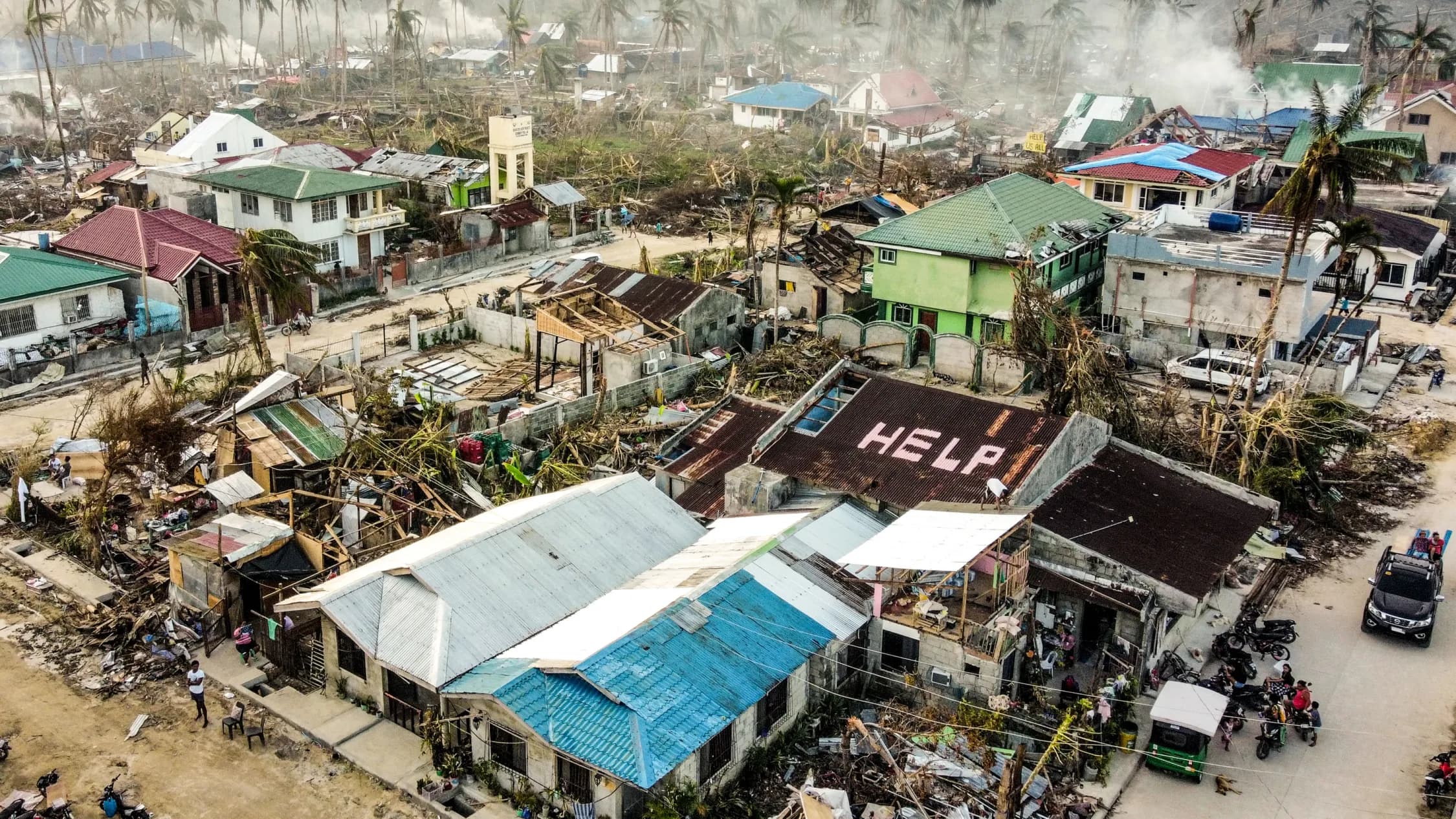
That scientific barrier is eroding fast. Modern attribution science no longer asks only whether climate change made a class of events “more likely.” It quantifies, with growing precision, how much a particular disaster was intensified – and how much different emitters contributed. A study underpinning a case against Shell in the Philippines, filed after Super Typhoon Odette killed hundreds and displaced nearly 800,000 people, concluded that climate change had doubled the likelihood of the extreme rainfall involved. More recent work published in Nature went further, estimating how much specific fossil-fuel companies contributed to 21st-century heat waves.
These advances are not just about better physics. They are about AI. High-resolution climate models increasingly rely on machine-learning techniques to emulate complex atmospheric processes, compress huge ensembles of simulations, and detect patterns in petabytes of observational and satellite data. Deep-learning models trained on decades of weather records and emissions inventories can now isolate the “fingerprint” of anthropogenic warming in single events and partition responsibility among major emitters. The same statistical rigor that underpins algorithmic trading or medical imaging is now being trained on climate causation.
Courts are catching up. A German court, in the landmark case brought by Peruvian farmer Saúl Luciano Lliuya against the utility RWE, declined to award damages but still held that major polluters can, in principle, be liable for climate harms proportional to their contribution. That is an extraordinary doctrinal shift: it recognises that diffuse, global emissions can ground concrete liability for local risks, such as a glacial lake outburst threatening one farmer’s land.
The European Court of Human Rights has now affirmed that states have positive obligations to protect people from climate impacts under human-rights law. National courts are following. Italy’s Court of Cassation opened the door in 2025 to climate-damages suits against fossil giant ENI, explicitly basing jurisdiction on its emissions and on the Paris Agreement. Dutch courts are hearing a case brought by residents of Bonaire against the Netherlands, demanding faster emissions cuts and adaptation on the basis of international human-rights and climate norms.
In parallel, plaintiffs in the Global South are testing cross-border corporate liability. Pakistani farmers devastated by the 2022 floods have sued German power and cement companies, arguing that their historical emissions materially increased the probability and severity of the deluge. Their lawyers are not waving vague charts about global averages; they are brandishing event-specific attribution studies, downscaled flood models, and detailed emissions histories. All of this evidence is increasingly produced, quality-controlled, and interrogated using AI.

AI is also transforming the legal construction process itself. Climate litigation now depends on scraping internal corporate documents, board minutes, and marketing campaigns to show that oil and gas companies “knew and lied” about climate risks. Modern e‑discovery systems deploy natural-language processing to identify patterns of deception and greenwashing across millions of pages, exposing the decision-making that prolonged fossil dependency. In construction and infrastructure disputes, AI-driven risk models simulate climate impacts on buildings, dams, and coastal defenses over their design life. Once those tools exist, courts can argue that failure to use them is negligence: a developer or public authority “ought to have known” how vulnerable their project was in a warmed world.
Regulatory battles are reinforcing the same trend. In the United States, industry challenges to California’s emissions disclosure laws (SB 261 and SB 253) are colliding with a wave of AI-enabled carbon accounting platforms that make Scope 1–3 tracking routine. Globally, mandatory climate risk reporting regimes – from Europe’s Corporate Sustainability Reporting Directive to emerging “climate Superfund” laws in Vermont and New York – are generating structured data on who emits what, where, and for whose benefit. AI systems ingest those disclosures, cross-reference them with satellite and market data, and produce increasingly granular liability maps. Litigators are already using that intelligence to select defendants, fashion claims, and calculate damages models.
The pattern is unmistakable: better AI-driven science, more receptive courts, and richer data flows are converging. Climate responsibility is acquiring the two things law demands – attribution and quantification – in forms judges can understand and plaintiffs can weaponise.
THE STRONGEST OBJECTION
The obvious pushback is that this is still wishful thinking. No court has yet rendered a blockbuster damages judgment against a major emitter for climate harms. Sovereign immunity shields states from many foreign suits. Even in receptive jurisdictions, defendants argue that causation is too diffuse and probabilistic: billions of emitters, trillions of emissions decisions, countless intervening factors between CO₂ in the atmosphere and a flooded village. Tort law, they say, is built for proximate causes and discrete accidents – not for the slow violence of global warming.
There is also resistance to relying on AI-heavy science in court. Corporate defendants already attack attribution studies as “black box” modeling, vulnerable to parameter choices and training data. Judges, wary of overstepping into policy-making, may hesitate to anchor multibillion-dollar verdicts on tools they do not fully understand. In the United States, federal preemption doctrines and earlier Supreme Court decisions have already clipped climate torts. Industry hopes that cases like Exxon Mobil and Suncor v. Boulder will yield a nationwide shield, shunting climate disputes back to paralyzed legislatures rather than letting juries apportion fault.
Even if a few plaintiffs win, the objection continues, enforcement will be patchy and slow. A judgment in a Dutch or Italian court does not automatically translate into cash for farmers in Pakistan or fishers in the Philippines. Multinationals can restructure, shift assets, and lobby for amnesties. Global South governments may trade away legal claims for investment or debt relief. AI might sharpen the moral clarity of who is responsible without delivering actual money or safety to those on the front lines.
WHY THE CLAIM HOLDS
Those objections underestimate how law changes once underlying facts become undeniable and administrable. Tort and human-rights regimes have long handled probabilistic causation – from toxic chemicals to asbestos to pharmaceutical side effects. Courts did not wait for perfect molecular tracing before holding tobacco companies liable; they relied on epidemiological statistics, internal documents, and shifting social norms. AI-enhanced attribution is the climate analogue of that epidemiology: a disciplined way to say, “this emitter made this harm significantly worse.”

Human-rights framing lowers the bar further. The European Court of Human Rights does not require a plaintiff to prove that a specific ton of CO₂ from a specific stack caused their flooded home. It asks whether the state took reasonable, science-informed steps to protect rights to life, health, and family life in the face of a known danger. Once AI-driven models clearly map that danger – including location-specific projections of sea-level rise, heat stress, or infrastructure failure – inaction becomes legally indefensible. The same logic is spreading into construction and planning law: if AI tools showed that a housing development on a floodplain would likely be underwater within decades, consent authorities and developers cannot credibly plead ignorance when the waters come.
The “black box” criticism of AI is eroding in practice. Courts increasingly demand transparency: model documentation, sensitivity analyses, cross-validation with independent methods. Attribution teams respond with hybrid approaches that combine traditional physics-based models with machine-learning accelerators, exposing assumptions and uncertainty ranges. Crucially, liability does not require razor-thin error bars; it requires that the defendant’s contribution be substantial and foreseeable. The evidentiary standard is “more likely than not,” not mathematical proof beyond doubt.
Structural barriers like sovereign immunity and U.S. preemption doctrines will slow the wave, not stop it. Climate liability does not need one global megacase. It needs a critical mass of enforceable judgments and settlements that alter incentives. A successful damages award in an Italian, Dutch, or Brazilian court – even if modest – will force insurers, auditors, and investors to reprice fossil-heavy business models worldwide. Climate risk will become climate liability risk, and AI-powered tools will be baked into due diligence. The moment boards must choose between paying shareholders dividends and paying court-ordered compensation for foreseeable climate harms, the politics of delay change.
As for enforcement, financial systems are far more globally integrated than legal systems. Oil majors raise capital, insure assets, and trade derivatives in jurisdictions where climate rulings will bite. Asset freezes, higher insurance premiums, adverse credit ratings, and mandatory climate reserves can all flow from a handful of precedents, amplified by AI-driven risk analytics in finance. You do not need every ton of CO₂ to be litigated. You only need enough legal clarity that continuing to emit and mislead becomes more expensive than transitioning.
THE IMPLICATION
If AI-powered attribution science and emerging case law stay on their current trajectory, climate justice will stop being purely aspirational and start becoming justiciable. Big emitters – states, utilities, oil and gas firms, cement giants, even large construction and property developers – will face a world where every new project is shadowed by a future liability ledger generated by machines. Plaintiffs from the Global South will not secure full “reparations” for centuries of emissions, but they will gain leverage: the credible threat of enforceable judgments backed by hard data.
That shift will not magically fix climate politics. It will, however, move the center of gravity. Instead of begging rich countries for climate finance, vulnerable communities will drag their polluters into court armed with AI-derived evidence that makes denial untenable. Corporate counsel will treat climate risk the way they treat bribery, product defects, or data breaches: as a legal exposure to be eliminated, not a PR issue to be managed. And in the process, AI – a technology often blamed for accelerating extraction and inequality – will become one of the sharpest tools available for forcing those who warmed the planet to finally pay for the damage they caused.